
Planting
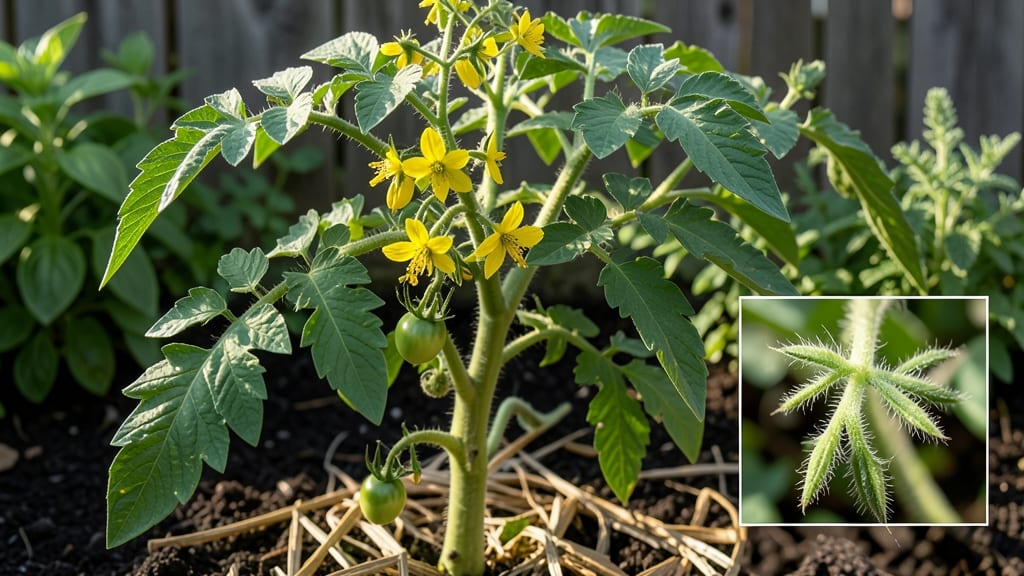
A tomato plant sucker looks like a small, thin shoot growing between the main stem and a leaf branch, often at a 45-degree angle. It lacks leaves and resembles a miniature stem with a pointed tip, emerging from the leaf axil (where the leaf meets the stem).
A tomato plant sucker is easy to spot once you know what to look for.
These shoots typically appear at the junction where a leaf meets the main stem, growing at an angled position rather than straight up like the main plant. 🌱 Unlike leaves or fruit stems, suckers are leafless and have a delicate, almost hair-like appearance, making them distinct from the thicker, leaf-bearing branches.
They often start as tiny buds before elongating into these thin stems, which can quickly divert energy from your plant's main growth if left unchecked.
What sets suckers apart from other growths is their location and structure. While blossom ends (where flowers develop) or lateral shoots (side branches) may have leaves, suckers remain bare and grow at that characteristic 45-degree angle.
This unique positioning is your first clue—anything growing directly between the main stem and a leaf is likely a sucker. Identifying them early helps you decide whether to prune them, as removing suckers can redirect your plant's energy toward fruit production rather than unnecessary foliage.
💡 In This Article
- Identifying Tomato Plant Suckers: Key Visual Characteristics
- When and How to Prune Tomato Suckers for Healthier Plants
Identifying tomato plant suckers: key visual characteristics
Suckers emerge specifically from the leaf axil, which is the V-shaped junction where a leaf stem meets the main plant stem. This precise location is your first clue—anything growing directly from that spot at a 45-degree angle is a sucker.
Unlike the main stem or lateral branches, which grow upward or outward, suckers angle downward slightly, creating a distinctive triangular shape when viewed from the side. Their stems are typically 1/8-inch to 1/4-inch thick, about the diameter of a pencil lead, and feel slightly softer than the main stem.
The most telling feature is their lack of leaves during early growth stages.
While lateral shoots may develop small leaves, suckers remain bare for the first 2-3 inches of growth, appearing as smooth, green shoots with just a pointed tip. 🌿 Compare this to blossom ends, which form at the base of leaves and eventually develop flowers or fruit—suckers never bear blossoms or fruit.
Their thin, delicate structure also makes them more prone to snapping if you're not careful during pruning.
Understanding the growth mechanics helps explain why suckers form. These shoots develop from auxiliary buds in the leaf axils, competing for the plant's energy. When you remove suckers early, you prevent them from growing into vigorous side branches that can shade fruit or harbor pests.
The key is acting quickly—suckers can grow 1-2 inches per day under ideal conditions, so regular inspections (every 5-7 days) are essential for control.
Lighting conditions can affect sucker visibility. In bright sunlight, suckers appear shiny and slightly waxy, while in shaded areas they may look duller.
Their color is usually a lighter green than the main stem, which helps them blend in if you're not looking closely. 🌞 This is why many gardeners recommend examining plants on overcast days, when the contrast between suckers and leaves is more pronounced.
Pay special attention to the lower third of the plant, where suckers are most common in indeterminate varieties.
For visual learners, think of suckers as nature's way of creating miniature versions of the main stem—they have the same structure but lack the leaf clusters.
This is why they're often called "water sprouts" in some gardening circles, as they can divert up to 20% of the plant's water and nutrient supply if left unchecked. The earlier you identify them, the easier it is to maintain your plant's focus on fruit production rather than foliage growth.
One common mistake is confusing suckers with lateral shoots, which do bear leaves and grow outward from the main stem.
Lateral shoots are thicker, more robust, and often develop into productive branches, while suckers remain weak and non-productive. 🌱 The rule of thumb is: if it's growing between a leaf and the main stem at an angle, it's a sucker—prune it.
If it's growing outward with leaves, it's likely a lateral shoot that you might want to keep for additional fruiting.